Your products change constantly.
A vehicle might arrive Monday, be photographed Tuesday and sell Saturday.
Prices change. Photos change. Mileage changes. Inventory ages. Leads arrive after hours. Shoppers compare your vehicle with five others across town before ever speaking with a salesperson.
Your website has to keep up.
That’s why a used car dealer website shouldn’t be treated like a normal small-business website with an inventory page bolted onto it.
It should function as a live digital extension of your lot.
This guide explains what independent used car dealers should expect from a modern website, which features actually matter, how inventory should work, how the website can generate leads, and how to build an online presence that belongs to your dealership.
What Is a Used Car Dealer Website?
A used car dealer website is an automotive website designed specifically to display changing vehicle inventory and turn online shoppers into dealership opportunities.
Unlike a standard business website, it typically needs to manage:
- Vehicle inventory
- Vehicle photos
- Pricing
- Mileage
- VINs
- Vehicle specifications
- Search and filters
- Individual Vehicle Detail Pages
- Financing inquiries
- Trade-ins
- Test-drive requests
- Phone calls
- CRM lead delivery
- Search-engine visibility
- Analytics
The inventory isn’t an extra feature.
It’s the heart of the website.
Why Independent Dealers Need a Different Kind of Website
Franchise and independent dealerships both sell vehicles, but their website requirements aren’t always identical.
Franchise dealerships may have manufacturer programs, OEM-approved vendors, mandated technology and large corporate marketing systems.
Independent dealers generally have more freedom.
That freedom can be an advantage.
You can choose:
- Your website provider
- Your technology
- Your CRM
- Your advertising
- Your design
- Your inventory strategy
- Your content
- Your SEO strategy
But that also means you need to decide which technology actually deserves your money.
An independent dealer website shouldn’t be a miniature version of a franchise dealer website.
It should be built around how your dealership operates.
Your Website Should Start With Your Inventory
A used car dealer’s website architecture should revolve around inventory.
The basic system looks like this:
YOUR INVENTORY SYSTEM
↓
INVENTORY FEED
↓
YOUR DEALER WEBSITE
↓
SEARCH RESULTS PAGES
↓
VEHICLE DETAIL PAGES
↓
SHOPPER ACTION
↓
CRM / SALES TEAM
Inventory should flow automatically whenever possible.
Your staff shouldn’t need to maintain the same vehicle manually in three different places.
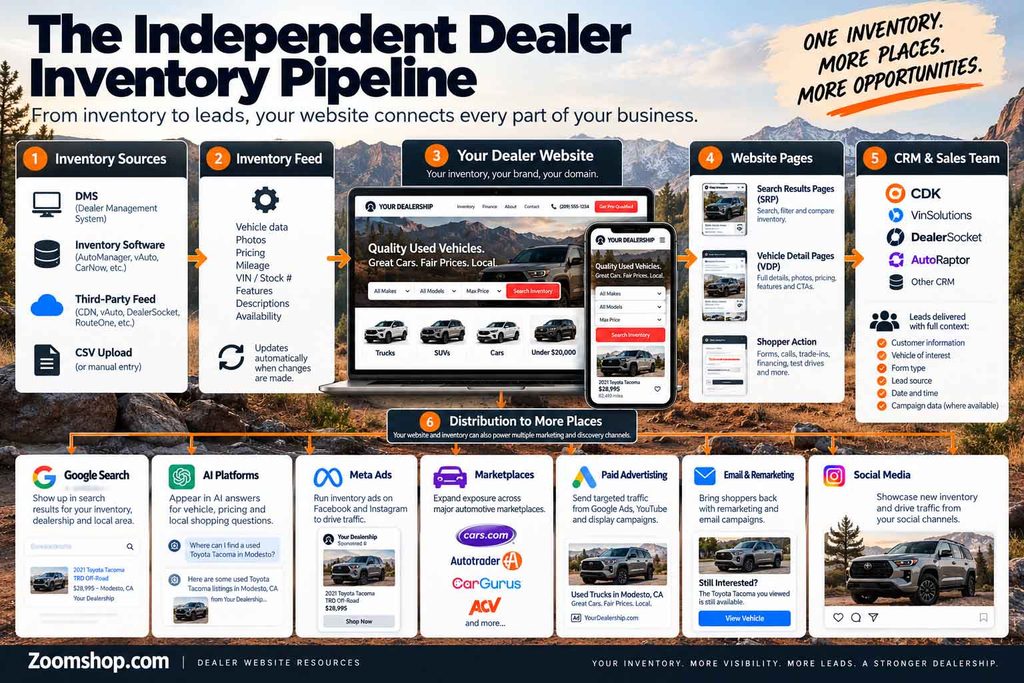
When a vehicle is added to your inventory system, the website should be able to receive information such as:
- Year
- Make
- Model
- Trim
- VIN
- Stock number
- Price
- Mileage
- Photos
- Features
- Vehicle description
- Availability
When information changes, the website should update.
When the vehicle sells, the website should know.
Simple idea.
Surprisingly important.
The Inventory Feed
Before choosing a website provider, find out exactly where your website inventory will come from.
It might originate from:
- Your DMS
- Inventory management software
- A third-party feed provider
- A CSV or data feed
- Direct website inventory management
Ask:
How often does inventory update?
How quickly do price changes appear?
Where do photos come from?
What happens when a vehicle sells?
What happens if the feed fails?
That last question is worth asking.
A website shouldn’t erase your entire inventory because an upstream feed had a bad afternoon.
Search Results Pages
The Search Results Page, or SRP, is your online lot.
Imagine physically arranging 150 vehicles without signs, categories or rows.
That’s what a bad SRP feels like.
Shoppers should be able to narrow inventory quickly.
Useful filters might include:
- Make
- Model
- Price
- Year
- Mileage
- Body style
- Drivetrain
- Fuel type
- Exterior color
Depending on your inventory, other filters may be useful.
A truck-heavy dealership might emphasize:
- 4WD
- Bed length
- Towing equipment
A luxury dealer might emphasize:
- Brand
- Features
- Certified status
A specialty off-road dealer might emphasize:
- Drivetrain
- Lift
- Equipment
- Modification
Your filters should reflect what your customers actually shop for.
Inventory Cards Should Help Shoppers Compare
Each SRP vehicle card should communicate the important information quickly.
At minimum:
Photo
Year / Make / Model
Trim
Price
Mileage
Potential additions include:
- Estimated payment
- Key features
- Value indicator
- Vehicle history indicator
- Availability
- Favorite/save function
The goal isn’t to squeeze the entire vehicle record onto a tiny card.
It’s to give the shopper enough information to decide:
I want to see this one.
Vehicle Detail Pages
The VDP is where a used vehicle becomes an individual product.
And used vehicles need good VDPs even more than new vehicles do.
Why?
Because two brand-new vehicles with the same trim can be nearly identical.
Two seven-year-old SUVs with 80,000 miles can be completely different.
Condition matters.
History matters.
Equipment matters.
Ownership matters.
Maintenance matters.
Photography matters.
Your VDP should tell that story.
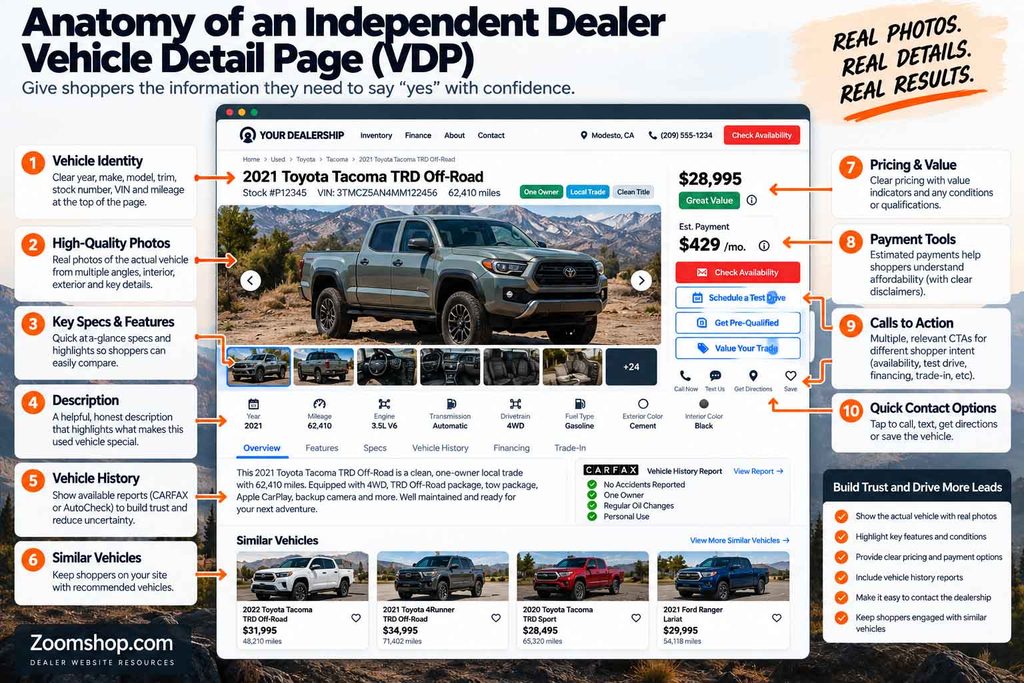
A useful used-car VDP should include:
- Vehicle title
- Price
- Mileage
- VIN
- Stock number
- Photos
- Specifications
- Features
- Description
- Vehicle history where available
- Payment information
- Financing options
- Trade-in CTA
- Test-drive CTA
- Availability CTA
- Phone number
- Dealership location
Don’t make shoppers work to figure out what you’re selling.
Used Vehicle Photography Matters
For used inventory, shoppers are evaluating the actual vehicle.
Stock photography isn’t enough.
Show them the car.
A useful photo set can include:
- Front three-quarter
- Rear three-quarter
- Driver side
- Passenger side
- Front
- Rear
- Dashboard
- Front seats
- Rear seats
- Cargo area
- Wheels
- Instrument cluster
- Infotainment
- Important options
And if the vehicle has something a shopper would reasonably want to inspect, show it.
Good photography doesn’t merely make inventory attractive.
It reduces uncertainty.
Write Better Used Vehicle Descriptions
Many dealer VDP descriptions are either empty or generated from generic equipment lists.
That’s a missed opportunity.
Compare:
2021 Toyota Tacoma SR5. Call for details.
with:
2021 Toyota Tacoma SR5 Double Cab 4WD with 62,410 miles. One-owner local trade equipped with Toyota Safety Sense, Apple CarPlay, backup camera and tow package.
One gives the shopper information.
The other gives them homework.
Descriptions don’t need to become novels.
Highlight what makes this particular used vehicle worth considering.
Pricing Should Be Easy to Understand
The price is one of the first things shoppers look for.
Don’t turn it into an archaeological expedition.
If the vehicle has an advertised selling price, display it clearly.
If conditions or qualifications apply, explain them appropriately.
If you provide payment estimates, make it clear that they are estimates and identify the assumptions used.
Transparency reduces friction.
A mysterious price doesn’t automatically generate a lead.
Sometimes it just generates a back button.
Payment Shopping
Used-car shoppers often shop by payment as much as purchase price.
That makes payment tools potentially useful.
A payment calculator might allow shoppers to adjust:
- Down payment
- Term
- Interest-rate assumption
- Trade value
The goal isn’t to promise a final finance contract.
It’s to help shoppers understand the relationship between:
Vehicle price → down payment → financing → estimated payment
This can also create useful inventory experiences such as:
Vehicles under an estimated $500/month
provided the assumptions are clearly communicated.
Financing for Independent Dealers
Financing can be especially important for independent dealerships.
Your website may support:
- Pre-qualification
- Finance applications
- Credit applications
- Lender integrations
- Buy Here Pay Here information
But be thoughtful about where you ask for information.
A shopper checking whether a vehicle is available probably doesn’t need to complete a full credit application.
Match the form to the intent.
Don’t Make Every Button the Same Form
A common dealer website problem looks like this:
CHECK AVAILABILITY
SCHEDULE TEST DRIVE
GET E-PRICE
ASK A QUESTION
Four buttons.
One identical form.
That’s not four conversion paths.
That’s one form wearing four hats.
Different shopper intentions deserve different experiences.
Check Availability
Vehicle + contact information.
Schedule Test Drive
Vehicle + contact + preferred date/time.
Ask a Question
Vehicle + question + contact.
Financing
Information relevant to financing.
Forms don’t need to be long.
They need to make sense.
Calls Matter
Independent dealers should make it extremely easy to call.
On mobile:
Tap → Call
Not:
Tap → menu → contact page → scroll → find number → reconsider life choices.
Phone numbers should be visible in important shopping contexts.
Call tracking can also help determine which marketing channels generate conversations.
Your Website Should Work After the Lot Closes
A physical dealership has business hours.
Your website doesn’t.
Someone may shop your inventory at:
11:30 PM.
6:00 AM.
Sunday afternoon.
During their lunch break.
While sitting on another dealership’s lot.
The website needs to answer as many basic questions as possible without requiring a salesperson to be present.
That’s one reason complete VDPs matter.
The more useful information shoppers can obtain independently, the easier it is for them to decide whether to contact you.
Local SEO for Independent Used Car Dealers
Independent dealerships often compete within a defined geographic area.
That makes local search especially important.
Potential searches include:
used cars near me
used cars in Modesto
used trucks Stockton CA
used Toyota RAV4 Modesto
used SUVs under $30,000 near me
Your website should clearly establish:
- Dealership name
- Address
- Phone
- Hours
- Inventory
- Geographic location
- Services
Google supports LocalBusiness structured data for communicating information such as business location and hours. (Google for Developers)
Your website and Google Business Profile should also describe the same real business.
Consistency makes everyone’s job easier, including Google’s.
Local Inventory Pages
Used inventory creates opportunities for highly specific local pages.
For example:
/used-cars/modesto-ca/
/used-trucks/modesto-ca/
/used-suvs/modesto-ca/
/used-toyota/modesto-ca/
These pages should be useful shopping destinations.
That means showing actual relevant inventory.
Don’t create hundreds of city pages containing nearly identical paragraphs simply because software allows it.
A local inventory page should help a shopper find vehicles.
Otherwise it’s just a city name wearing an SEO costume.
Every Vehicle Is a Search Opportunity
Each VDP contains highly specific information:
2022 Toyota Tacoma TRD Off-Road
4WD
48,000 miles
Modesto, California
That combination may match searches far more specific than:
used cars
This is why crawlable VDPs matter.
A vehicle page should have a stable, usable URL and enough actual content for search engines to understand what it represents.
What Happens When the Vehicle Sells?
Used inventory disappears constantly.
That creates an SEO and user-experience question.
What should happen to the VDP?
There isn’t one universal answer.
Depending on the circumstances, a sold vehicle page might:
- Remain temporarily available and show SOLD
- Recommend similar vehicles
- Link to the relevant make/model inventory
- Redirect to a highly relevant replacement page
What you generally want to avoid is creating thousands of useless dead ends.
Someone landing on a sold vehicle still represents a shopper.
Give them somewhere useful to go.
Structured Data for Used Car Websites
Structured data gives machines explicit information about page content.
For a dealership, structured information can help describe:
- Business
- Location
- Vehicle/product
- Price
- Availability
- Breadcrumbs
Google recommends using the most specific appropriate Organization or LocalBusiness subtype for physical businesses and including applicable business details. (Google for Developers)
The point isn’t to cover the website in schema for sport.
The point is clarity.
Machines should be able to determine:
This is a dealership.
It is located here.
This page represents this vehicle.
This vehicle has this price.
Clear data creates a stronger technical foundation for search and machine-driven discovery.
Used Car Websites and AI Search
Shoppers can increasingly ask complete questions:
Where can I find a used Toyota Tacoma under $35,000 near me?
Who has used third-row SUVs in Modesto?
Find me an AWD SUV under $30,000.
That creates a new discovery opportunity.
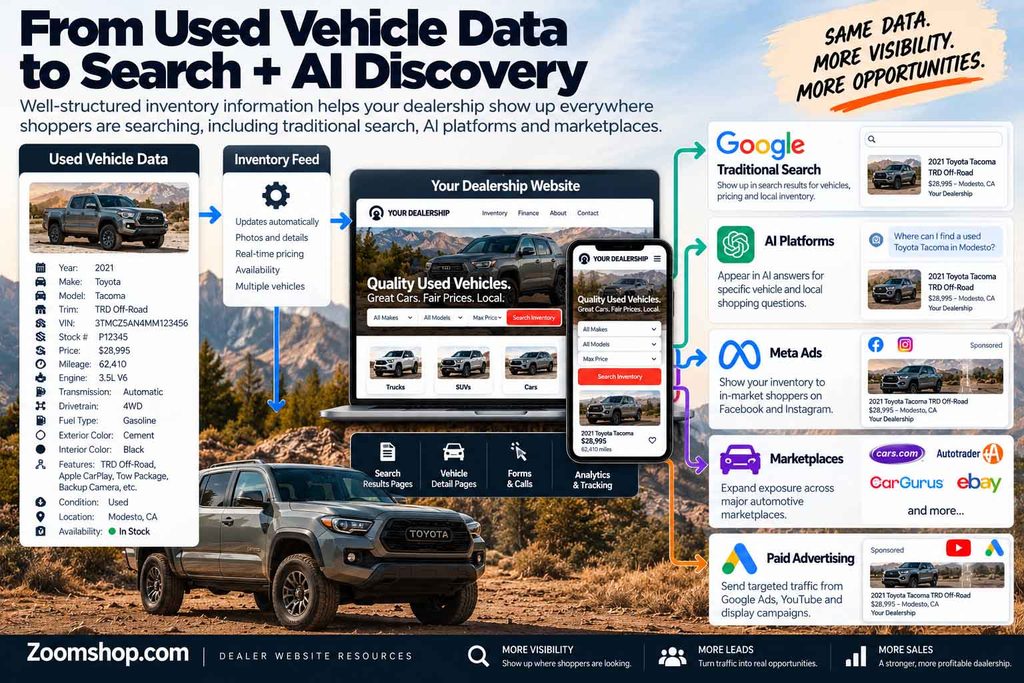
Your website should make inventory information easy to understand.
That means:
- Crawlable pages
- Clear vehicle titles
- Accurate pricing
- Vehicle specifications
- Structured data
- Clear dealership information
- Useful local pages
- Descriptive internal links
Don’t write content for robots.
Organize information clearly enough that robots don’t misunderstand what humans already understand.
Marketplace vs Your Own Website
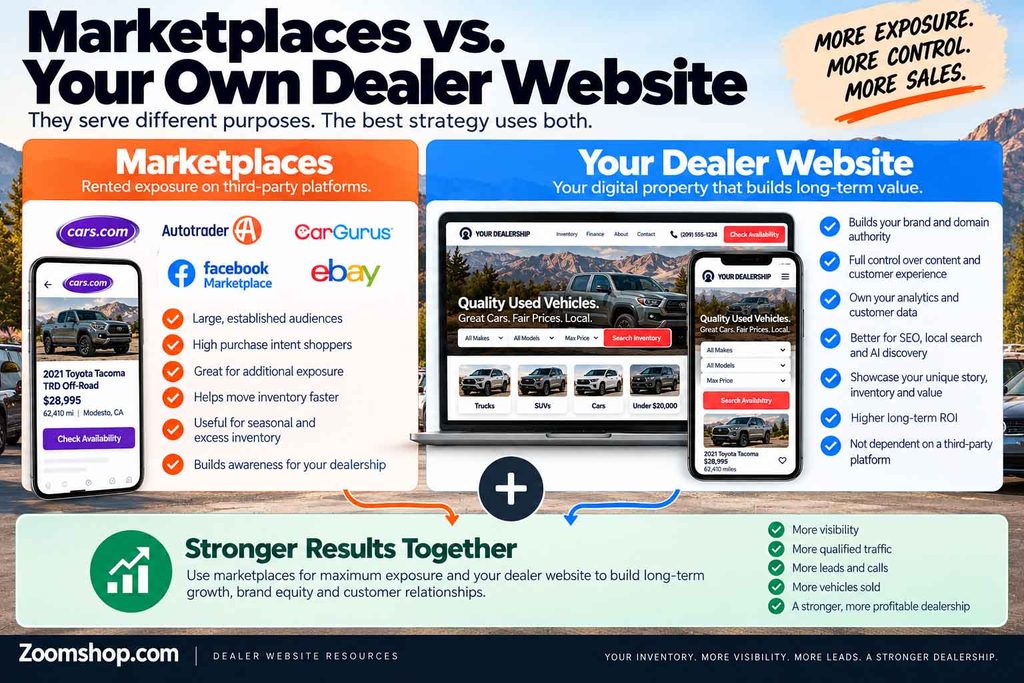
Marketplaces can be valuable.
They put inventory in front of shoppers.
That’s good.
But a marketplace and your dealership website serve different strategic purposes.
A marketplace rents you exposure.
Your website builds your own digital property.
Ideally, these can work together.
MARKETPLACES
Expose inventory to shoppers already using those platforms.
YOUR WEBSITE
Builds:
- Your brand
- Your domain
- Your organic visibility
- Your first-party analytics
- Your content
- Your customer experience
This isn’t necessarily an either/or decision.
The stronger strategy may be:
Marketplace exposure + strong dealership website
rather than expecting one to replace the other.
Facebook and Social Media Aren’t Your Website
Social media is useful for:
- Inventory promotion
- Video
- Community
- Retargeting
- Reviews
- Awareness
But your social profile isn’t a substitute for a dealership website.
You don’t control the platform.
You don’t control the algorithm.
You don’t control how inventory is indexed.
Your website should be the stable home of the dealership.
Social platforms can send people there.
Your Domain Matters
Whenever practical, operate the dealership on a domain you control.
For example:
yourdealership.com
rather than making a third-party marketplace subdomain your primary digital identity.
Why?
Because your domain can accumulate:
- Links
- Mentions
- Search visibility
- Content
- Authority
- Brand recognition
over time.
If you switch website providers later, the domain can remain yours.
The technology underneath can change.
The address stays home.
CRM Integration
Website leads need somewhere to go.
A modern independent dealer website should support reliable lead delivery into the dealership’s CRM or lead-management process.
A lead should ideally carry useful context such as:
- Shopper
- Vehicle
- Form type
- Lead source
- Date/time
- Campaign information where available
A test-drive lead shouldn’t arrive as:
Website Lead
with no indication what vehicle the customer wanted.
Context makes follow-up easier.
Analytics
Independent dealers don’t need a 94-page analytics dashboard.
They do need answers.
How many people are shopping inventory?
Which vehicles receive the most attention?
Where are leads coming from?
Which marketing sources generate calls?
Which pages generate forms?
Are shoppers reaching VDPs?
What percentage of traffic is mobile?
Which inventory isn’t getting attention?
Your website should help answer these questions.
Useful systems can include:
- Google Analytics
- Google Search Console
- Call tracking
- CRM reporting
- Advertising attribution
Make sure the dealership has access to its own accounts and data.
Mobile Is the Dealership Website
For many shoppers, the mobile version isn’t a secondary version of your website.
It is the website.
Test it yourself.
Not from your office computer.
Use your phone.
Turn off Wi-Fi.
Search inventory.
Use filters.
Open photos.
Calculate a payment.
Call.
Submit a form.
Schedule a test drive.
If something annoys you, imagine doing it while comparing three dealerships.
Fix it.
Used Car Website Speed
Used car websites can become heavy because they combine:
- Large photos
- Inventory feeds
- Chat
- Analytics
- Advertising scripts
- Trade tools
- Payment tools
- Financing
- Reviews
- Third-party widgets
Every integration adds something.
Sometimes that something is useful.
Sometimes it’s just JavaScript luggage.
Test real pages regularly, particularly:
Homepage
SRP
VDP
The VDP matters more than winning a performance trophy on an empty homepage.
Trust Matters More for Used Vehicles
Used-car shoppers are evaluating more uncertainty than new-car shoppers.
Your website can reduce that uncertainty.
Useful trust signals may include:
- Real vehicle photography
- Vehicle history information
- Reviews
- Inspection information
- Warranty information where applicable
- Transparent dealership contact information
- Clear pricing
- Accurate vehicle descriptions
- Dealership history
- Staff information
Don’t manufacture trust.
Provide evidence.
Small Independent Lots Don’t Need Enterprise Bloat
A 40-car independent dealership probably doesn’t need the same technology stack as a 20-rooftop franchise group.
That’s okay.
Evaluate features based on actual need.
A smaller dealership may primarily need:
- Great inventory
- Fast website
- Strong VDPs
- Mobile usability
- Calls
- Forms
- Financing
- CRM delivery
- Local SEO
- Analytics
The goal isn’t to own the most software.
It’s to sell vehicles.
Used Car Dealer Website Cost
Used car website pricing varies significantly.
Current independent-dealer platforms demonstrate how wide the market has become. Some advertise plans around $60–$100 per month, while other providers offer more extensive automotive website and dealership technology packages. (SPARQsites)
Don’t compare sticker price alone.
Compare:
Website
Inventory
Hosting
Domain
CRM
Feeds
SEO
Support
Setup
Integrations
Contracts
Add-ons
The cheapest advertised price isn’t necessarily the lowest total cost.
And the most expensive system isn’t automatically the best.
Questions to Ask a Used Car Website Provider
Before signing anything, ask:
Inventory
Where does inventory come from?
How frequently does it update?
What happens when a feed fails?
How are sold vehicles handled?
Domain
Do I control my domain?
Can I keep it if I leave?
Website
Are individual VDPs crawlable?
Can layouts and CTAs be changed?
Is the site genuinely mobile friendly?
SEO
Can I edit page titles and content?
Can local inventory pages be created?
Are sitemaps maintained?
What happens to SEO if I leave?
Leads
Where do forms go?
Can they integrate with my CRM?
Can different forms contain different information?
Are failures monitored?
Analytics
Do I control GA4?
Do I control Search Console?
Can I install Tag Manager?
Can I track calls?
Cost
What is my complete monthly cost?
Are there setup fees?
Are integrations extra?
Is there a long-term contract?
What does cancellation cost?
Get the answers before your domain is pointing at somebody else’s server.
Used Car Dealer Website Checklist
A strong independent dealer website should provide:
INVENTORY
✓ Automatic inventory updates
✓ Searchable inventory
✓ Useful filters
✓ Accurate pricing
✓ Vehicle photos
VDP
✓ Unique vehicle pages
✓ VIN and stock number
✓ Mileage
✓ Specifications
✓ Features
✓ Description
✓ Clear pricing
✓ Relevant CTAs
CONVERSION
✓ Click-to-call
✓ Check availability
✓ Test-drive request
✓ Financing
✓ Trade-in
✓ CRM delivery
SEARCH
✓ Crawlable inventory
✓ Useful page titles
✓ Structured data
✓ Local dealership information
✓ Internal linking
✓ XML sitemap strategy
MOBILE
✓ Fast pages
✓ Usable filters
✓ Easy photos
✓ Simple forms
✓ Large tap targets
OWNERSHIP
✓ Your domain
✓ Your analytics
✓ Your content
✓ Your data
If your website can’t check most of those boxes, there may be considerably more opportunity than changing the homepage banner.
How Zoomshop Approaches Independent Dealer Websites
Zoomshop was designed around the idea that independent dealers shouldn’t have to choose between a generic small-business website and an expensive enterprise automotive platform.
The dealership should have its own digital property.
That means combining:
- Your domain
- Your inventory
- SRPs
- VDPs
- Local search architecture
- Structured vehicle information
- AI-readable content
- Lead generation
- CRM delivery
- Analytics
- Advertising feeds
into one automotive website platform.
The objective is simple:
Make your inventory easier to find.
Make vehicles easier to shop.
Make the dealership easier to contact.
And make the website something the dealership actually owns and builds value in over time.
Frequently Asked Questions
Does an independent used car dealer need a website?
A dealership can technically operate without one, but a website provides a digital property the dealer controls where shoppers can browse current inventory, learn about the business and contact the dealership directly.
How much does a used car dealer website cost?
Pricing varies widely. Current independent-dealer platforms range from inexpensive software subscriptions to larger automotive technology packages costing considerably more. Compare total costs, features, integrations and contracts rather than monthly price alone. (SPARQsites)
Can my dealership use WordPress?
Yes. However, WordPress doesn’t natively provide automotive inventory feeds, SRPs, VDPs, vehicle structured data or CRM integrations. Those systems need to be built or added separately.
Should every used vehicle have its own page?
Generally, each vehicle should have a useful individual VDP so shoppers and machines can access its specific photos, price, mileage, VIN, equipment and availability.
Should I list my inventory on marketplaces too?
Marketplaces can provide valuable additional exposure. Your own dealership website and third-party marketplaces can complement each other rather than being mutually exclusive.
Should my dealership own its domain?
Maintaining control of the dealership’s primary domain helps preserve its long-term digital identity and makes changing technology providers easier.
Can used car inventory appear in AI search?
AI-powered systems can use publicly accessible web information, but inclusion isn’t guaranteed. Clear, crawlable and well-structured inventory information gives machine-driven systems a better foundation for understanding a dealership’s vehicles.
What is the most important part of a used car website?
Inventory is the foundation, but inventory alone isn’t enough. Strong VDPs, mobile usability, clear pricing, relevant calls to action, lead delivery, local visibility and analytics work together to turn inventory into opportunities.
Your Lot Deserves Its Own Digital Property
Marketplaces change.
Social platforms change.
Algorithms change.
Website providers change.
Your dealership shouldn’t disappear every time the technology underneath it changes.
Build around assets you control:
Your dealership.
Your inventory.
Your domain.
Your content.
Your customer relationships.
Technology should strengthen those assets.
Not replace them.
That’s what a modern independent dealer website should do.
See how your current dealer website stacks up
Run your website through the free Zoomshop dealer website grader — Core Web Vitals, mobile setup, structured data, Google visibility, accessibility, and more. Instant scorecard, no signup.