It’s an inventory system, merchandising platform, search engine asset, lead generator, advertising destination and increasingly a structured source of information for AI-powered search.
That changes what a dealership should expect from its website.
A good dealer website shouldn’t merely look modern.
It should help shoppers find the right vehicle, understand what they’re looking at, take the next step, and connect with the dealership without friction.
Behind the scenes, it should make the dealership and its inventory easy for search engines, advertising platforms, analytics systems and other software to understand.
This guide explains how modern car dealer websites work, what they should include and what dealerships should pay attention to in 2026 and beyond.
What Is a Car Dealer Website?
A car dealer website is a website specifically designed to market a dealership and its vehicle inventory.
Unlike a typical business website, a dealership website may contain hundreds or thousands of dynamically changing vehicle pages and needs to connect with inventory systems, CRM software, analytics, advertising platforms and other automotive technology.
A modern dealer website commonly includes:
- New and used vehicle inventory
- Search Results Pages
- Vehicle Detail Pages
- Vehicle photos and specifications
- Pricing
- Payment estimates
- Trade-in tools
- Finance forms
- Test-drive requests
- Availability requests
- Specials
- Dealership information
- Service information
- Lead forms
- CRM integration
- Analytics
- Search-engine optimization
- Structured data
The website is essentially the dealership’s digital showroom.
Unlike the physical showroom, it’s open around the clock and can potentially serve thousands of shoppers simultaneously.
A Modern Dealer Website Is a System, Not a Homepage
It’s easy to evaluate a dealership website by looking at the homepage.
That’s probably the least interesting way to evaluate one.
Most serious shoppers aren’t visiting a dealership website to admire the homepage.
They’re trying to answer questions.
Do you have the vehicle I want?
How much is it?
What features does it have?
What would my payment look like?
Is it still available?
Can I trade my current vehicle?
Can I schedule a test drive?
How do I contact you?
The website should make those answers easy to find.
Behind that experience is an interconnected technology stack.
A dealership website may receive inventory information from a DMS or inventory provider, turn that data into searchable inventory and individual vehicle pages, send leads into a CRM, report activity to analytics platforms and provide information to search engines, advertising systems and AI-powered discovery tools.
That’s why evaluating only the homepage can be misleading.
The machinery underneath matters just as much as the paint.
The Essential Parts of a Car Dealer Website
Let’s break the website into its most important components.
1. Homepage
The homepage should quickly answer three questions:
Who are you?
What do you sell?
What should I do next?
A dealer homepage doesn’t need to contain everything the dealership has ever wanted to say.
Its primary purpose is navigation and orientation.
Useful homepage elements may include:
- Inventory search
- New and used inventory links
- Featured vehicles
- Specials
- Trade-in CTA
- Financing CTA
- Service CTA
- Dealership location
- Phone number
- Hours
- Reviews or reputation signals
- Primary dealership differentiators
The homepage should create obvious paths into inventory.
Don’t make shoppers hunt for the cars.
2. Search Results Pages
A Search Results Page, usually called an SRP, is where shoppers browse inventory.
For many dealership websites, this is one of the most important page types on the entire site.
A good SRP helps someone move from:
“Show me your used vehicles.”
to:
“Show me these five vehicles.”
Useful filters can include:
- Condition
- Make
- Model
- Year
- Price
- Mileage
- Body style
- Drivetrain
- Fuel type
- Exterior color
- Features
Filters should help shoppers narrow inventory without creating unnecessary complexity.
Inventory Cards
Each vehicle card should provide enough information to help someone decide whether to open the VDP.
That might include:
- Primary photo
- Year
- Make
- Model
- Trim
- Price
- Mileage
- Key features
- Estimated payment
- Availability or detail CTA
The goal isn’t to put the entire VDP on the SRP.
It’s to make comparison easy.
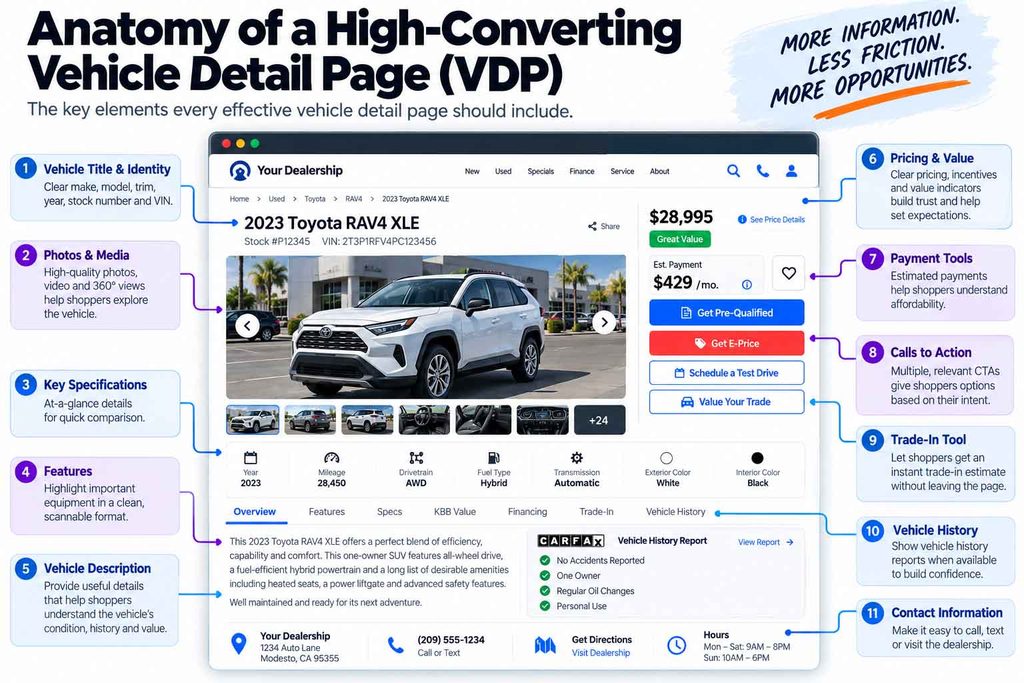
3. Vehicle Detail Pages
The Vehicle Detail Page, or VDP, is where browsing becomes shopping.
Someone who opens a VDP has expressed interest in a specific vehicle.
The page should capitalize on that intent.
[INSERT GRAPHIC: ANATOMY OF A HIGH-CONVERTING VDP]
A strong VDP can include:
Vehicle Identity
Clearly display:
- Year
- Make
- Model
- Trim
- Stock number
- VIN
Photos
Vehicle photos are one of the shopper’s primary sources of information.
They should be:
- Large enough to inspect
- Easy to navigate
- Mobile friendly
- Fast loading
- Representative of the actual vehicle whenever possible
Price
Pricing should be easy to locate and understand.
If additional qualifications or conditions apply to an advertised price, those should be disclosed appropriately.
Key Specifications
Useful information can include:
- Mileage
- Engine
- Transmission
- Drivetrain
- Fuel type
- Exterior color
- Interior color
- Body style
Features
Highlight meaningful equipment rather than burying everything inside an enormous wall of text.
Vehicle Description
Descriptions can provide additional context that raw inventory data doesn’t communicate.
This is especially valuable for used vehicles.
For example:
One-owner trade. AWD. Heated seats. Apple CarPlay. New tires installed during inspection.
That’s much more useful than repeating the VIN.
Calls to Action
Potential actions include:
- Check availability
- Schedule a test drive
- Call the dealership
- Get pre-qualified
- Value your trade
- Ask a question
- Get directions
The shopper shouldn’t need to scroll through a digital obstacle course just to contact the dealership.
4. Mobile Experience
A dealer website isn’t truly mobile friendly because the desktop page technically shrinks onto a phone.
The experience needs to work on a phone.
That means thinking about:
- Navigation
- Inventory filters
- Photo galleries
- Forms
- Phone buttons
- Payment tools
- Sticky CTAs
- Tap targets
- Text size
- Page speed
A shopper standing in another dealer’s lot comparing your vehicle with the one in front of them is not a theoretical use case.
Your mobile website may literally be competing for a sale while that person is shopping.
Make it easy.
5. Lead Generation
Traffic isn’t the final objective.
Action is.
Dealership websites should provide several reasonable ways for shoppers to move forward because different shoppers have different levels of intent.
Someone might be ready to:
Call now.
Someone else might only be willing to:
Check availability.
Another shopper may want:
Schedule a test drive.
And another may begin with:
What is my trade worth?
The website should support these different levels of intent.
Don’t Turn Every CTA Into the Same Form
This is a subtle but important point.
If your website has buttons labeled:
CHECK AVAILABILITY
SCHEDULE TEST DRIVE
GET E-PRICE
ASK A QUESTION
and every button opens exactly the same generic form, the interface is promising choices that don’t really exist.
The form should reflect the action.
A test-drive request should ask about scheduling.
An availability request should focus on the vehicle.
A trade-in request should collect relevant trade information.
Context matters.
Phone Calls Are Conversions Too
Dealer websites sometimes become obsessed with forms while ignoring phone calls.
That’s a mistake.
Make phone numbers easy to find and easy to tap on mobile devices.
Where possible, call tracking can help identify:
- Traffic source
- Campaign
- Landing page
- Vehicle
- Marketing channel
The objective isn’t merely generating leads.
It’s understanding where valuable leads originate.
6. CRM Integration
A form submission isn’t particularly useful if nobody receives it.
Website leads should be delivered reliably into the dealership’s lead-management process.
A good website/CRM connection should consider:
- Lead source
- Vehicle information
- Customer information
- Form type
- Rooftop
- Department
- Timestamp
- Campaign attribution where available
Multi-rooftop dealer groups need to be especially careful about routing.
A lead for Dealer A should not mysteriously wander into Dealer B’s CRM because someone misconfigured a form.
7. Analytics and Conversion Tracking
A dealership should know what its website is doing.
That means tracking more than pageviews.
Useful website events can include:
- Form submissions
- Phone clicks
- Test-drive requests
- Availability requests
- Finance starts
- Trade-in submissions
- Directions
- VDP views
- SRP engagement
- Inventory searches
This allows the dealership to evaluate traffic quality rather than simply traffic quantity.
Ten thousand visits mean very little if nobody shops inventory or contacts the dealership.
8. Search Engine Optimization
A dealership website can create an enormous organic-search footprint.
Consider all the information available:
Dealership
Location
Brands
Services
Inventory
Vehicles
Make
Model
Year
Trim
Body style
Fuel type
Price
Features
Condition
Geography
City
Nearby cities
County
Region
Those attributes create legitimate search opportunities.
For example:
Used Toyota RAV4 in Modesto
Used BMW SUVs in Stockton
Used cars under $25,000
Used AWD SUVs near Sacramento
Used hybrid vehicles near me
The website architecture should help search engines understand those relationships.
Every Vehicle Should Have a Useful URL
Individual inventory pages should generally have their own crawlable URLs.
Those pages should contain useful information about the actual vehicle.
But dealerships should also think carefully about what happens when a vehicle sells.
Immediately turning every sold VDP into a dead end can create a poor experience for users and search engines.
Depending on the implementation, a sold page can potentially:
- Show that the vehicle has sold
- Recommend similar inventory
- Link back to the relevant model or category
- Redirect appropriately when there is a strong replacement
There isn’t one universal solution for every situation.
The important thing is to have a strategy.
Local SEO for Car Dealers
Dealerships are inherently local businesses.
That makes location information important.
The website should clearly communicate:
- Dealership name
- Address
- Phone number
- Hours
- Departments
- Brands
- Service area
- Directions
Google supports LocalBusiness structured data that can provide additional business information such as address, phone number and operating hours.
Consistency matters.
Your website, Google Business Profile and other important business listings shouldn’t tell three different stories about who you are or where you’re located.
Local Inventory Landing Pages
Local pages can be useful when they’re based on real shopper needs and actual inventory.
For example:
/used-cars/modesto-ca/
/used-toyota-rav4/stockton-ca/
/used-suvs/tracy-ca/
But there is an important distinction.
A useful landing page helps someone shop.
A doorway page merely swaps city names inside generic text.
The first can provide value.
The second is SEO confetti.
A useful inventory-backed local page might contain:
- Relevant current inventory
- Meaningful local context
- Pricing information
- Helpful buying information
- Dealership location and directions
- FAQs
- Links to related inventory
Create pages because they solve searches, not because software makes it possible to generate 20,000 URLs before lunch.
9. Structured Data
Search engines don’t experience websites the same way humans do.
Structured data provides explicit machine-readable information about page content.
Google describes structured data as a standardized format for providing information about a page and classifying its content.
For dealerships, structured information can help machines understand relationships involving:
- The dealership
- Business location
- Vehicles
- Products
- Offers
- Prices
- Availability
- Breadcrumbs
Structured data doesn’t guarantee rankings or special search features.
It helps reduce ambiguity.
And reducing ambiguity is becoming increasingly valuable.
Vehicle Structured Data
Vehicle pages contain unusually structured information by nature.
A vehicle has:
- Make
- Model
- Year
- VIN
- Mileage
- Price
- Condition
- Color
- Transmission
- Fuel type
Machines shouldn’t have to reverse-engineer that information from visual page layouts.
Google’s current Product documentation specifically notes that Car isn’t automatically supported as a subtype of Product for its shopping features and instructs eligible implementations to use both Product and Car when appropriate.
The larger lesson is straightforward:
Automotive structured data should be implemented deliberately rather than by guessing what Google wants.
10. AEO and AI Discovery
SEO isn’t disappearing.
Discovery is expanding.
Consumers increasingly ask complete questions rather than typing fragments.
Instead of:
used suv modesto
someone can ask:
Where can I find a used three-row SUV under $35,000 near Modesto?
That changes how content can be structured.
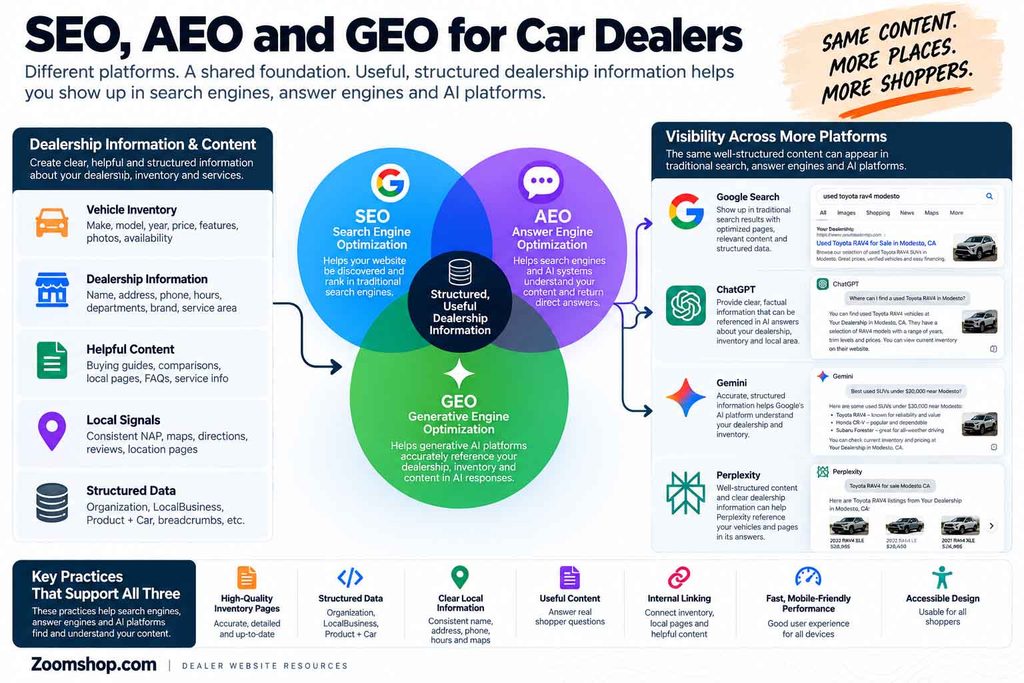
Dealer websites should make important information explicit.
Helpful practices include:
- Clear headings
- Concise answers
- Logical page structure
- Consistent dealership information
- Machine-readable vehicle information
- Crawlable text
- Descriptive links
- Original dealership content
- Useful FAQs
- Strong internal linking
The objective isn’t to write weird robot prose.
Quite the opposite.
Write clearly enough that humans and machines reach the same conclusion about what the page means.
11. Website Speed
Dealer websites can become heavy.
Very heavy.
Large vehicle photos are combined with:
- Chat software
- Analytics
- Advertising pixels
- Digital retailing
- Trade tools
- Finance tools
- Personalization
- Call tracking
- Review widgets
- Third-party scripts
Eventually the website starts carrying the digital equivalent of a roof rack filled with bricks.
Every third-party script should earn its place.
Dealers should regularly test:
- Homepage
- SRP
- VDP
- Lead forms
Don’t assume that because the homepage performs well, inventory pages do too.
12. Accessibility
Accessibility should be part of the underlying website experience.
Consider:
- Keyboard navigation
- Form labels
- Heading structure
- Alternative text
- Color contrast
- Focus indicators
- Error messages
- Navigation
- Buttons
- Modal windows
Accessibility is bigger than installing a floating accessibility button.
The underlying website still needs to work.
13. Content
Dealership content shouldn’t exist only because somebody said:
“We need four blogs this month.”
Content should answer real questions.
Useful dealership content might include:
Vehicle Comparisons
Toyota RAV4 vs Honda CR-V
Buying Guides
Best used SUVs under $30,000
Ownership Information
What to look for when buying a used hybrid
Local Information
Best vehicles for commuting from Tracy to the Bay Area
Inventory Guides
What does Certified Pre-Owned mean?
Finance Education
How vehicle trade-ins work
Service Education
When should brake fluid be replaced?
Useful content creates entry points into the dealership beyond individual inventory listings.
14. Internal Linking
Pages shouldn’t live on islands.
A guide about used hybrid vehicles can link to current hybrid inventory.
A model page can link to relevant VDPs.
A VDP can link to similar vehicles.
A local inventory page can link to financing.
Financing can link back to inventory.
This helps shoppers move through the website and helps search engines understand relationships between pages.
Think of the website as a map rather than a filing cabinet.
15. Inventory Merchandising
Good inventory data isn’t enough.
Presentation matters.
Compare these two experiences:
2024 Toyota RAV4 XLE
versus:
2024 Toyota RAV4 XLE AWD | One Owner | Heated Seats | Apple CarPlay
They’re describing the same vehicle.
One tells a better story.
Dealers should look for opportunities to improve:
- Vehicle titles
- Photography
- Descriptions
- Feature highlights
- Pricing presentation
- Payment information
- Similar-vehicle recommendations
Inventory merchandising is where website technology meets actual retailing.
What Should a Modern Dealer Homepage Look Like?
There isn’t one perfect layout.
But there should be a clear hierarchy.
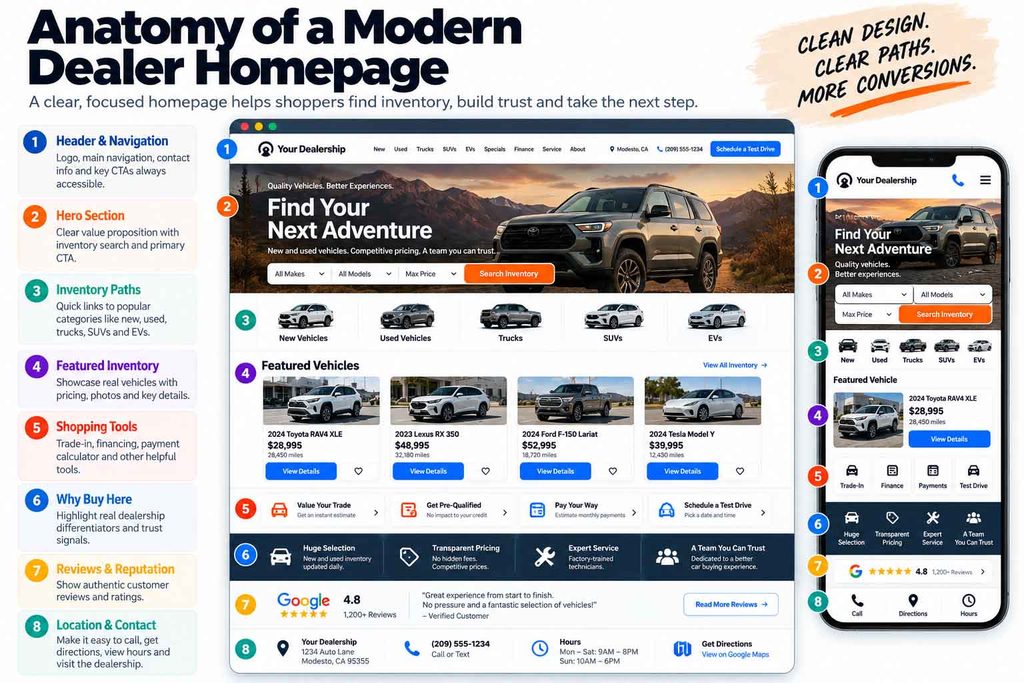
A useful homepage structure might look like:
1. Header
Logo
Inventory
Finance
Service
Contact
Phone
2. Hero
Clear dealership proposition
Inventory search
Primary CTA
3. Inventory Paths
New
Used
Trucks
SUVs
EVs
Other high-value categories
4. Featured Inventory
Actual vehicles
5. Shopping Tools
Trade-in
Financing
Payments
Test drive
6. Why Buy Here
Real dealership differentiators
7. Reviews / Reputation
Authentic trust signals
8. Location
Address
Hours
Phone
Directions
The homepage doesn’t need to win an art contest.
It needs to move people.
What Should a Dealer Website Avoid?
Some problems appear repeatedly across dealership websites.
Too Many Popups
Chat.
Trade.
Coupons.
Email capture.
Digital retail.
Exit intent.
Special offer.
At some point the shopper is no longer browsing a dealership website.
They’re playing whack-a-mole.
Too Many Calls to Action
More buttons don’t automatically create more conversions.
Prioritize the actions that matter.
Slow Third-Party Scripts
Every integration carries a performance cost.
Measure whether the benefit justifies it.
Generic Content
Changing “Fresno” to “Modesto” doesn’t magically create useful local content.
Hidden Contact Information
A shopper shouldn’t need detective training to find a phone number.
Poor Mobile Forms
Long forms are particularly painful on phones.
Ask only for information you actually need at that stage.
Dead-End Sold Vehicles
If someone reaches a sold vehicle, help them continue shopping.
Don’t simply hand them a 404 page and wish them luck.
The Dealer Website Conversion Funnel
A useful way to evaluate the website is to think about the shopper’s progression.
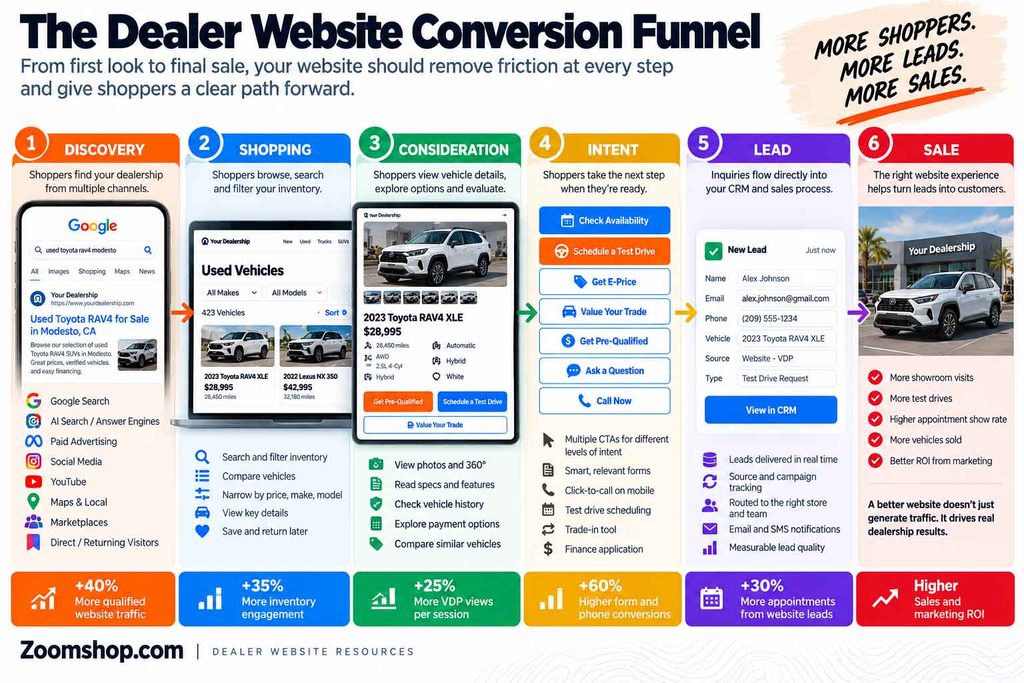
DISCOVERY
Google
AI search
Advertising
Social
Marketplace
Direct visit
↓
SHOPPING
Homepage
Landing page
SRP
↓
CONSIDERATION
VDP
Photos
Features
Price
Payment
Vehicle history
↓
INTENT
Check availability
Test drive
Trade-in
Finance
Phone call
↓
LEAD
CRM
Call
Appointment
↓
SALE
The website doesn’t control every step.
But it should remove friction between them.
How Do You Know if a Dealer Website Is Working?
Don’t judge it using one number.
Look at the complete picture.
Useful metrics can include:
- Organic search visibility
- Inventory page traffic
- SRP engagement
- VDP views
- VDPs per session
- Form submissions
- Phone calls
- Test-drive requests
- Finance leads
- Trade leads
- Directions
- Lead-to-appointment rate
- Appointment-to-sale rate
- Cost per lead
- Cost per sale
Ultimately, website traffic is valuable when it contributes to dealership outcomes.
More sessions alone don’t automatically mean a better website.
Car Dealer Website Checklist
Use this checklist when evaluating your existing website.
Inventory
✓ Inventory updates automatically
✓ Sold inventory is handled appropriately
✓ Filters work correctly
✓ Vehicle data is accurate
VDP
✓ Large vehicle photos
✓ Price is easy to understand
✓ Specifications are complete
✓ Features are readable
✓ CTAs are obvious
✓ Phone number is accessible
✓ Similar vehicles are available
Mobile
✓ Navigation works well
✓ Filters are usable
✓ Forms are easy
✓ Calls require one tap
✓ Photos load quickly
SEO
✓ Important pages are crawlable
✓ Titles are descriptive
✓ Canonical URLs are correct
✓ XML sitemaps are maintained
✓ Internal linking exists
✓ Local pages provide actual value
Structured Data
✓ Dealership information is marked up appropriately
✓ Vehicle/product information is structured where appropriate
✓ Breadcrumbs are implemented
✓ Markup is validated
Leads
✓ Forms work
✓ CRM delivery is tested
✓ Lead sources are preserved
✓ Phone calls are tracked appropriately
Analytics
✓ GA4 is installed
✓ Search Console is configured
✓ Important conversion events are tracked
✓ Dealer controls its accounts
Accessibility
✓ Keyboard navigation works
✓ Forms have labels
✓ Images support alt text
✓ Focus states are visible
✓ Page structure is logical
Performance
✓ Homepage tested
✓ SRP tested
✓ VDP tested
✓ Third-party scripts reviewed
If several of these items are missing, the website may have more opportunity than a simple redesign would suggest.
Car Dealer Websites and the Future of Automotive Shopping
The role of the dealership website is changing.
For years, the primary model was:
Shopper → Google → Dealer Website
Now the paths are multiplying.
A shopper might discover a vehicle through:
Google.
Google Maps.
Instagram.
Facebook.
YouTube.
A marketplace.
An AI assistant.
An advertisement.
A vehicle-shopping service.
Or an interface that doesn’t exist yet.
That makes the dealership’s underlying information increasingly important.
Inventory should be accurate.
Pages should be crawlable.
Vehicle information should be structured.
Dealership information should be consistent.
Content should be useful.
And the website should remain the dealership’s authoritative digital source.
The interface will change.
Good data travels.
Frequently Asked Questions About Car Dealer Websites
What is a car dealer website?
A car dealer website is a website designed specifically for automotive dealerships. It typically combines dealership information with searchable vehicle inventory, individual vehicle pages, lead-generation tools, financing options and integrations with dealership systems.
What should a car dealer website include?
At minimum, a modern dealership website should include searchable inventory, individual Vehicle Detail Pages, dealership contact information, mobile-friendly navigation, lead forms, phone CTAs, financing information, CRM integration, analytics and appropriate search-engine optimization.
What is a VDP?
VDP stands for Vehicle Detail Page. It is the individual page containing information about a specific vehicle, including photos, price, mileage, specifications, features and calls to action.
What is an SRP?
SRP stands for Search Results Page. It is the page where shoppers browse and filter dealership inventory.
Do car dealer websites need SEO?
Dealer websites can benefit significantly from SEO because vehicle inventory, models, vehicle categories, dealership services and local searches create many potential organic-search entry points.
What is automotive structured data?
Structured data is machine-readable information that helps search engines understand what a page represents. Dealership implementations can describe information about the business, products, vehicles, offers, locations and navigation.
Can AI systems find dealership inventory?
AI-powered discovery increasingly depends on crawlable, clearly structured and accessible information. There is no guarantee that a particular AI system will surface a dealership or vehicle, but making inventory and dealership information clear, consistent and machine-readable improves discoverability across machine-driven systems.
Should every vehicle have its own webpage?
Individual vehicles generally benefit from having unique, crawlable VDP URLs because each vehicle contains specific information such as VIN, price, mileage, equipment and availability.
Should a dealership own its website domain?
A dealership generally benefits from controlling its primary domain because the domain represents its long-term digital identity and can preserve continuity when technology vendors change.
How often should dealership inventory update?
Inventory should update frequently enough that website availability and pricing accurately reflect the dealership’s source inventory. The appropriate interval depends on the dealership’s systems and provider.
Building a Better Dealer Website
A better dealership website isn’t necessarily the one with the most features.
It’s the one where the pieces work together.
Inventory feeds the website.
The website helps shoppers find vehicles.
VDPs answer questions.
Calls to action create leads.
Leads reach the CRM.
Analytics show what happened.
Search engines understand the pages.
AI systems can understand the information.
And the dealership maintains control of its digital presence.
That’s the standard modern dealer websites should be working toward.
Looking for a Modern Dealer Website Platform?
Zoomshop was built specifically around this approach.
Instead of treating the dealership website as a collection of templates, Zoomshop combines automotive inventory, VDPs, SRPs, conversion tools, structured data, local search architecture, AI-oriented content, CRM lead delivery and analytics into one dealer website platform.
You can explore Zoomshop, compare it with your current website, or use our dealer website resources to determine what your dealership actually needs.
Because the goal isn’t to have another dealer website.
It’s to have one that works.
See how your current dealer website stacks up
Run your website through the free Zoomshop dealer website grader — Core Web Vitals, mobile setup, structured data, Google visibility, accessibility, and more. Instant scorecard, no signup.