A dealership website has to do much more than look good. It needs to keep vehicle inventory current, create individual vehicle pages, work properly on mobile devices, generate leads, connect with dealership systems, help search engines understand inventory, support local search visibility, and increasingly make dealership information understandable to AI-powered search and answer engines.
The best way to choose a dealer website provider isn’t to ask which company has the flashiest demo.
It’s to understand what the website actually needs to accomplish.
This guide explains how dealership website platforms work, what features matter, what questions to ask a provider, common pricing models, and how to compare your options.
Quick Answer: What Is a Car Dealer Website Provider?
A car dealer website provider is a company or software platform that builds and operates websites specifically for automotive dealerships. Unlike a general website builder, a dealer website platform typically handles vehicle inventory feeds, search results pages (SRPs), vehicle detail pages (VDPs), lead forms, CRM delivery, automotive structured data, dealership locations, financing tools and other dealership-specific functions.
Some providers focus primarily on franchise dealerships. Others specialize in independent used car dealers. Some bundle websites with marketplaces, advertising, DMS software or other automotive services.
The right choice depends on what your dealership needs the website to own and accomplish.
Why a Dealer Website Is Different From a Normal Business Website
A normal small-business website might have 10 or 20 relatively static pages.
A dealership website can have hundreds or thousands of changing URLs.
Every vehicle may generate its own Vehicle Detail Page. Inventory changes daily. Prices change. Vehicles are sold. New vehicles arrive. Photos change. Incentives change.
That makes a dealership website part website, part inventory database and part sales platform.
A modern dealer website may need to manage:
- Vehicle inventory feeds
- Search Results Pages
- Vehicle Detail Pages
- Vehicle photos and specifications
- Pricing
- Payment estimates
- Finance applications
- Trade-in tools
- Test-drive requests
- Availability requests
- Phone and form attribution
- CRM lead delivery
- Dealership location information
- Search-engine structured data
- Local landing pages
- Accessibility
- Analytics
- Advertising integrations
This is why comparing a dealership website with a generic five-page business website isn’t particularly useful.
They are different products.
The Modern Dealer Website Technology Stack
A dealership website sits in the middle of several systems.
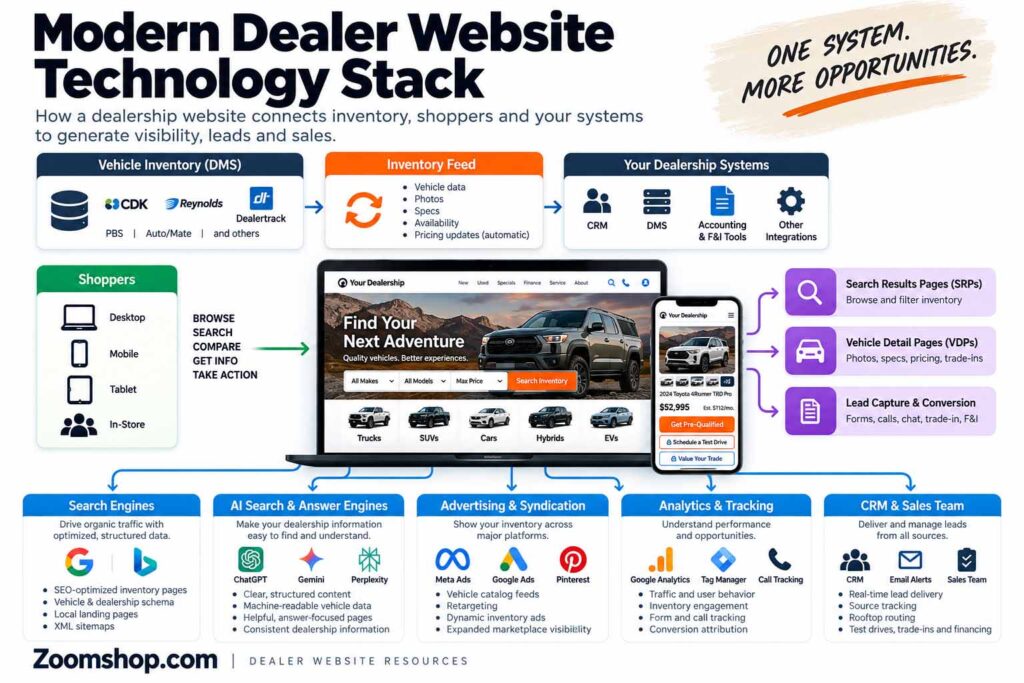
The basic flow looks something like this:
INVENTORY / DMS
↓
Inventory Feed
↓
DEALER WEBSITE
↓
SRPs → VDPs → Offers → Forms
↓
CRM
↓
Sales Team
At the same time:
DEALER WEBSITE
↓
Google / Bing / Search Engines
DEALER WEBSITE
↓
AI Search & Answer Engines
DEALER WEBSITE
↓
Google Analytics / Advertising Platforms
DEALER WEBSITE
↓
Facebook / Instagram / Vehicle Catalogs
The website therefore acts as a hub connecting inventory, shoppers, search engines, advertising platforms and dealership sales systems.
When evaluating a provider, don’t evaluate only what the homepage looks like.
Evaluate the entire system.
The Three Main Types of Car Dealer Website Providers
Most dealer website solutions fall into one of three broad categories.
1. Traditional Automotive Website Platforms
These are dedicated automotive technology companies providing dealership websites and often additional marketing or retailing products.
They may offer:
- Automotive website templates
- Inventory integrations
- OEM programs
- Digital retailing
- Advertising
- SEO services
- Personalization
- Analytics
- Lead-generation tools
These platforms are common among franchise dealerships and larger dealer groups.
They can provide deep automotive integration, although pricing, contracts, customization and included services can vary significantly.
2. Marketplace-Connected Dealer Websites
Some automotive marketplaces also offer dealership websites.
These can be attractive to independent dealers because they may combine:
- Marketplace exposure
- Inventory management
- Vehicle syndication
- Dealer website
- Lead generation
The important question is where your dealership’s digital equity is being created.
Ask whether shoppers, URLs, content, inventory pages and organic visibility primarily strengthen your dealership’s domain or the marketplace itself.
3. Independent Dealer Website Platforms
A newer category focuses on providing the automotive functionality of a traditional dealer platform while giving the dealership greater control over its own domain, design, data and marketing.
These platforms can vary widely.
Some are inexpensive template systems. Others are custom or semi-custom platforms with inventory automation, CRM integrations, SEO tools and conversion features.
The category itself doesn’t determine quality.
The underlying technology does.
What Should a Car Dealer Website Include?
At minimum, we believe a serious dealership website should provide the following.
Your Own Domain
Your dealership should operate on a domain you control.
The domain is an important long-term business asset because links, mentions, indexed pages and organic visibility can accumulate around it over time.
Before signing with a provider, ask:
Who owns the domain?
And:
What happens to it if we cancel?
Those two questions are surprisingly important.
Automatic Inventory Sync
Dealership inventory changes too quickly to manage manually.
Your website should be capable of receiving inventory from your existing inventory or DMS feed and updating vehicles automatically.
Price changes should update.
New vehicles should appear.
Sold vehicles should disappear appropriately.
Photos and vehicle data should remain synchronized.
Ask the provider what happens when a feed fails, too. A bad inventory import should not suddenly erase an entire dealership’s website inventory.
Search Results Pages
The SRP is where shoppers browse available inventory.
A good SRP should make it easy to filter and sort vehicles without turning the page into a maze.
Useful filters may include:
- New or used
- Make
- Model
- Body style
- Price
- Payment
- Year
- Mileage
- Drivetrain
- Fuel type
- Features
The exact filters depend on the dealership and inventory.
The objective is simple:
Help shoppers get from “we have 300 vehicles” to “these are the six I care about.”
Vehicle Detail Pages
Every vehicle should have a useful individual VDP.
A VDP should provide enough information for a shopper to decide whether the vehicle deserves the next step.
That may include:
- Price
- Photos
- Mileage
- VIN
- Stock number
- Specifications
- Features
- Vehicle description
- Payment estimate
- Dealership information
- Availability CTA
- Test-drive CTA
- Financing CTA
- Trade-in options
- Phone number
A VDP shouldn’t make someone solve a puzzle to contact the dealership.
Dealer Websites and Google Vehicle Inventory
Vehicle inventory isn’t just content for human shoppers.
It can also be structured so search engines can better understand it.
Google supports vehicle listing data for eligible dealerships in the United States. Vehicle information can be provided through inventory feeds or structured data markup on dealership websites.
That makes clean inventory architecture increasingly important.
A vehicle page should not simply look like a vehicle listing.
Machines should be able to understand what the page represents.
Structured Data for Dealer Websites
Structured data provides machines with explicit information about page content.
Depending on the page and implementation, useful structured data can include information describing:
- The dealership
- Vehicle
- Offer
- Price
- Availability
- Breadcrumbs
- Organization
- Local business
- FAQs or other supported content types where appropriate
Structured data does not magically create rankings.
It does make the meaning of content easier for machines to interpret.
That distinction matters.
A modern dealer website should be understandable to both humans and machines.
SEO Is More Than Ranking the Homepage
One of the biggest missed opportunities on dealership websites is treating SEO as:
“Make the dealership homepage rank.”
Inventory creates far more possibilities.
Consider the difference between one generic page and searches such as:
Used Toyota RAV4 in Modesto
Used trucks under $40,000
Used three-row SUVs near Stockton
Used Lexus RX in Oakland
Hybrid SUVs for sale near me
Used AWD vehicles under $30,000
Each search represents a different shopper need.
A dealership website architecture can potentially create useful inventory-backed pages that match those needs.
The key word is useful.
Generating thousands of empty pages simply to target keywords is not a strategy.
Pages should exist because the dealership actually has relevant inventory or useful information to provide.
What About AEO and AI Search?
Search behavior is expanding beyond the traditional list of blue links.
Consumers can now ask search engines and AI assistants complete questions.
For example:
“What are the best used SUVs under $30,000 near Sacramento?”
“Where can I find a used Toyota RAV4 near Modesto?”
“What should I look for when buying a used EV?”
“Which dealers near me have used third-row SUVs?”
That creates another requirement for dealer websites.
Information shouldn’t merely exist.
It should be easy to extract and understand.
That means using:
- Clear page titles
- Logical headings
- Concise answers
- Structured vehicle information
- Consistent dealership information
- Descriptive internal links
- Crawlable inventory
- Useful local content
- Strong entity information
- Original dealership information
The objective isn’t to “trick AI.”
It’s to remove ambiguity.
SEO, AEO and GEO: What’s the Difference?
These terms overlap considerably.
SEO
Search Engine Optimization focuses on helping pages become discoverable and useful through traditional search engines.
AEO
Answer Engine Optimization focuses on making information easy for systems to identify and return as direct answers.
GEO
Generative Engine Optimization generally refers to improving how clearly a brand, entity or source can be understood and potentially referenced by generative AI systems.
You do not need three completely separate websites or strategies.
A well-built page can support all three.
Useful content, clear entities, strong technical architecture, structured information and credible sources benefit the entire discovery ecosystem.
Mobile Performance Matters
Vehicle shopping frequently involves large photos, inventory filters, third-party scripts, tracking systems, chat tools and digital retailing products.
That creates a recipe for slow websites.
Every additional script deserves scrutiny.
Ask potential website providers:
- How does the platform perform on mobile?
- Can we test live customer websites?
- What happens when third-party tools are installed?
- Who monitors performance?
- Can unnecessary scripts be removed?
- Do we have control over third-party integrations?
Don’t judge performance using a provider’s demo alone.
Test actual dealership websites using the platform.
Accessibility Should Be Part of the Website
Accessibility shouldn’t be treated as a floating button added after a website has been built.
A website should be designed and coded so people using keyboards, screen readers and other assistive technology can actually navigate and understand it.
When evaluating a provider, ask specifically how accessibility is implemented.
Questions include:
- Is accessibility built into the underlying templates/components?
- Can the website be navigated by keyboard?
- Are forms properly labeled?
- Do images support alternative text?
- Are headings logically structured?
- Is contrast considered?
- Are focus states visible?
- How are accessibility issues tested?
An accessibility widget and an accessible website are not necessarily the same thing.
CRM Integration
Generating a lead is only half the job.
The lead needs to arrive at the correct place.
Dealer website providers should be able to explain exactly how leads are delivered and attributed.
Ask:
- Which CRMs are supported?
- How are leads transmitted?
- Is source information preserved?
- Can different rooftops route independently?
- What happens when delivery fails?
- Is failed lead delivery monitored?
- Can forms be tested?
- Can we use our own CRM?
A beautiful contact form that quietly fails is just modern art.
Website Analytics and Data Ownership
Your dealership should understand what happens on its website.
At minimum, discuss access to:
- Google Analytics
- Google Search Console
- Google Tag Manager
- Advertising pixels
- Form submissions
- Phone-call tracking
- Lead sources
- Inventory engagement
- Conversion events
Also ask who owns the data.
If you change providers, determine what you can export and retain.
Your dealership’s website should create business intelligence, not a black box.
How Much Does a Car Dealer Website Cost?
There is no universal dealer website price.
The market includes inexpensive independent-dealer systems, standalone automotive website platforms, bundled marketplace products, custom websites and enterprise franchise solutions.
Pricing can range from relatively inexpensive monthly subscriptions to thousands of dollars per month depending on the platform, dealership size, services and integrations.
That makes comparing only the monthly website fee misleading.
Instead, calculate the total website cost.
TOTAL WEBSITE COST =
Platform Fee
- Setup
- Hosting
- Inventory Feed
- Additional Locations
- SEO
- Support
- Integrations
- Lead Fees
- Required Add-ons
- Contract Exit Costs
Ask every provider for the complete monthly cost based on the functionality you actually intend to use.
Then compare equivalent systems.
Questions to Ask Every Dealer Website Provider
Before choosing a provider, ask these questions.
Ownership
Who owns my domain?
Who owns the website data?
What can I export?
What happens when I cancel?
Contract
Is there a long-term agreement?
Is there an early termination fee?
Does pricing change after an introductory period?
Inventory
How does inventory reach the website?
How frequently does it update?
What happens when the feed fails?
How are sold vehicles handled?
SEO
Are VDPs crawlable?
Can I edit titles and metadata?
Are canonical URLs implemented correctly?
Are inventory pages included in XML sitemaps?
Can useful local inventory pages be created?
Structured Data
What structured data is included?
How is vehicle data represented?
How is dealership information represented?
Can it be tested with Google’s tools?
AI Discovery
Can AI/search systems crawl the site?
Is important information rendered in crawlable HTML?
Are dealership entities clearly defined?
Can answer-oriented content be created?
Accessibility
How is accessibility implemented?
Is it built into the site or provided primarily through an overlay?
How is accessibility tested?
Leads
Where do forms go?
How are they attributed?
What happens if CRM delivery fails?
Can I test every lead path?
Analytics
Do I receive access to analytics?
Can I use my own GA4 property?
Can I use Google Tag Manager?
Can I access Search Console?
Performance
Can you show me live customer sites?
What do their mobile Core Web Vitals look like?
What third-party scripts are required?
Customization
Can layouts change?
Can CTAs change?
Can page templates change?
Can we create completely custom pages?
Or are we choosing different colors for essentially the same website?
The Dealer Website Provider Scorecard
Instead of selecting a provider based on a demo presentation, score each candidate using the same criteria.
| Category | Questions |
|---|---|
| Domain ownership | Do you control the domain? |
| Inventory | Is inventory automatically synchronized? |
| VDPs | Are pages complete, fast and crawlable? |
| SRPs | Is inventory easy to search and filter? |
| SEO | Can pages be optimized individually? |
| Local SEO | Can useful inventory-backed local pages be created? |
| Structured data | Is dealership and vehicle information machine-readable? |
| AI discovery | Is important content crawlable and clearly structured? |
| Accessibility | Is accessibility built into the underlying site? |
| Mobile performance | Do real dealer sites perform well? |
| CRM | Are leads delivered and monitored correctly? |
| Analytics | Does the dealer control its analytics accounts and data? |
| Customization | Can the site actually be changed? |
| Contract | How easy is it to leave? |
| Total cost | What is the true monthly cost after add-ons? |
A provider should be able to answer these questions clearly.
If the answers require interpretive dance, keep asking.
Don’t Choose a Dealer Website Based Only on Design
Design matters.
But design is one layer.
Two websites can look almost identical while performing completely differently underneath.
One may have:
- Clean semantic HTML
- Strong structured data
- Fast server response
- Crawlable inventory
- Accessible navigation
- Proper lead attribution
The other may simply look nice.
The best dealer website combines design, technology, merchandising, discoverability and conversion.
Franchise Dealers vs Independent Dealers
The decision can also be different depending on the dealership.
Franchise Dealerships
Franchise dealers may have:
- OEM website requirements
- Approved vendor lists
- Manufacturer incentives
- Required integrations
- Larger inventory
- Multiple departments
- Fixed operations
- Dealer group requirements
OEM compliance therefore becomes part of provider selection.
Independent Dealers
Independent dealers generally have more freedom.
That makes factors such as these particularly important:
- Price
- Inventory automation
- Marketplace independence
- Domain ownership
- Financing tools
- CRM compatibility
- Local SEO
- Ease of management
- Contract flexibility
Freedom is useful only if the dealership uses it.
Should You Build Your Own Dealer Website?
Sometimes.
A dealership with technical resources can build a website using WordPress or another general platform.
The difficulty isn’t usually creating the homepage.
It’s everything that comes afterward.
You need to solve:
Inventory synchronization.
Vehicle URLs.
Search and filtering.
Structured vehicle data.
Sold inventory.
Lead routing.
Payment tools.
CRM integrations.
Security.
Performance.
Accessibility.
Updates.
Analytics.
That doesn’t mean a custom dealer website is a bad idea.
It means the comparison should include the cost of maintaining the automotive infrastructure, not simply the cost of hosting WordPress.
How Zoomshop Approaches Dealer Websites
Zoomshop is one option within this market.
We built Zoomshop around a relatively simple idea:
The dealership’s website should strengthen the dealership.
Zoomshop websites operate on the dealership’s own domain and combine automotive inventory functionality with local search architecture, AI-readable content, accessibility, conversion tools and CRM lead delivery.
Current Zoomshop capabilities include:
- Automatic inventory feed synchronization
- Search Results Pages
- Rich Vehicle Detail Pages
- Local inventory landing pages
- AI-oriented answer pages
- Vehicle and dealership structured data
- CRM lead delivery
- Meta catalog feeds
- Payment estimation
- Finance and contact forms
- WCAG-focused accessibility
- Customizable design
- Multi-rooftop routing
- Analytics and attribution
Zoomshop is month-to-month rather than requiring a multi-year website contract.
Single-rooftop pricing currently starts at $148 per month.
Dealer groups with two to five rooftops are currently $498 per month total.
Enterprise groups are custom priced.
But this guide isn’t suggesting that every dealer automatically needs Zoomshop.
Use the scorecard above.
Compare us with the alternatives.
Run the tests.
Ask the uncomfortable questions.
A website provider should be able to survive comparison.
A Simple Dealer Website Evaluation Process
If we were evaluating a dealer website provider today, we’d use this process.
Step 1: Get Three Live Customer Websites
Don’t evaluate only the provider’s own website.
Ask for actual dealerships using the platform.
Step 2: Test Them on Mobile
Browse inventory.
Filter vehicles.
Open VDPs.
Submit a test form if the dealer permits it.
Try navigating without a mouse.
Step 3: Test Performance
Run representative pages through performance tools.
Test:
- Homepage
- SRP
- VDP
One fast homepage doesn’t prove the inventory experience is fast.
Step 4: Inspect Search Visibility
Search for dealership inventory.
Look at indexed pages.
Inspect VDP URLs.
Check local searches.
Step 5: Inspect Structured Data
Use structured-data testing tools to see what machines can actually understand.
Step 6: Ask About Ownership
Domain.
Data.
Analytics.
Content.
Leads.
Step 7: Calculate Total Cost
Include every required add-on.
Step 8: Read the Exit Terms
The best time to understand how you leave a website provider is before you join one.
The Future of Dealer Websites
Dealer websites are evolving from digital brochures into structured automotive data platforms.
The website still has to persuade humans.
But it increasingly has another audience:
Machines.
Search engines need to understand the dealership.
Google needs to understand the inventory.
Advertising platforms need accurate product data.
Analytics platforms need meaningful events.
AI systems need clear facts and relationships.
CRMs need structured leads.
That means tomorrow’s best dealership website isn’t merely attractive.
It’s understandable.
To people.
To search engines.
To software.
And to whatever shopping interface comes next.
Frequently Asked Questions
What is the best car dealer website provider?
There isn’t one provider that is automatically the best fit for every dealership. Franchise requirements, inventory size, budget, integrations, customization, contract terms and marketing strategy can change the answer. Compare providers using the same criteria rather than relying on a generic ranking.
How much does a car dealer website cost?
Dealer website pricing varies considerably. Low-cost platforms can cost well under $200 per month, while larger automotive platforms and bundled marketing solutions can reach hundreds or thousands of dollars per month. Compare total cost, including setup, integrations, inventory feeds, SEO, add-ons and contract requirements.
Does a car dealership need a special website platform?
Not necessarily, but dealership websites require functionality that general websites usually don’t provide automatically, including inventory synchronization, SRPs, VDPs, vehicle data, lead routing and automotive integrations.
Should a dealer own its domain?
Generally, a dealership should maintain control of its primary domain. Domain control makes changing providers easier and helps preserve the dealership’s long-term digital identity.
What is a VDP?
VDP stands for Vehicle Detail Page. It is the individual page describing a specific vehicle for sale.
What is an SRP?
SRP stands for Search Results Page. On a dealership website, it is typically the inventory browsing page where shoppers search, filter and compare available vehicles.
Can dealership inventory appear directly in Google?
Eligible U.S. dealerships can provide vehicle inventory information to Google through supported vehicle feeds or vehicle listing structured data.
Does schema improve dealership SEO?
Structured data helps search engines understand page content and entities. It isn’t a guarantee of higher rankings, but properly implemented structured data can improve machine understanding and may make pages eligible for supported search features.
What should I ask a dealer website provider before signing?
Ask about domain ownership, contract length, inventory feeds, VDP indexing, structured data, mobile performance, accessibility, CRM delivery, analytics access, customization, total cost and what happens if you leave.
What happens to SEO when changing dealer website providers?
It depends heavily on the migration. Existing URLs, redirects, page content, inventory architecture, internal links, metadata and technical configuration should be considered before launch. Poor migrations can unnecessarily discard existing search equity.
Ready to Compare Your Current Dealer Website?
You don’t have to switch platforms to find out where your current website stands.
Run your dealership website through the Zoomshop Website Grader to evaluate key areas of the experience and identify opportunities worth investigating.
Or talk with us about your current platform, inventory feed and CRM.
No interpretive dance required.
See how your current dealer website stacks up
Run your website through the free Zoomshop dealer website grader — Core Web Vitals, mobile setup, structured data, Google visibility, accessibility, and more. Instant scorecard, no signup.